
Add a content block
For electricians and electrical contractors
Electrical quoting software for electricians and installers
ExtraflowDoc prices electrical work the way it is actually counted: by point, by circuit and by metre, with materials and labour on separate lines, with notification and testing priced rather than absorbed, and with the exclusions that matter written down before anybody opens a wall.
- Quotes
- Estimates
- Proposals
- Contracts
- Work orders
- Purchase orders
- Delivery notes
- Invoices
Free plan available. No card needed. Or price a job in the browser without installing a thing.
Free plan, no cardQuote from the vanE-signature included
See it in action
What's Inside ExtraflowDoc?
Explore 15 screenshots for a better understanding — click any screenshot to view it full-screen.
Cover page and quotation block
Line item with a product photo
Line items and the block picker
Warranty section and running totals
Photo gallery with numbered callouts
PDF preview — cover page
PDF preview — quotation
PDF preview — line items and totals
PDF preview — signature block
Cover, quotation, and line items
Scope, terms, and signatures
ExtraflowDoc inside a Pipedrive deal
Start from a document or a template
Quotation block settings
Built for work that gets counted
What an electrical quote has to get right
Electrical work is counted before it is priced — points, circuits, metres, ways in the board. The quote has to survive that count being wrong, because half of what you priced is still behind a wall.
Priced by point, by circuit and by metre
Twenty-two downlights, nine double sockets, four new circuits, sixty metres of cable: each is a line with its own quantity and rate rather than one lump sum you defend afterwards. When the customer adds two sockets during the survey you change one quantity, and the total, VAT and margin follow it.
Materials at cost plus mark-up, labour at your day rate
Cable, accessories and the consumer unit run at cost plus a percentage you set per line; your time runs at a day rate or a price per point. Keeping the two apart is what lets you answer «why are you dearer than the other quote» with a materials difference rather than a shrug.
Notification, commissioning and testing as priced lines, not a favour
The building control notification, the commissioning visit and the testing with certification at the end are real hours and real fees. Put them in the quote as their own lines and they are services the customer agreed to buy; leave them out and they are an evening you give away at the end of every job.
Provisional sums and exclusions, because it is behind the plaster
You are pricing a house you can only half see. A provisional sum line for what the walls might hold, and an exclusions block naming what you have not allowed for — making good, asbestos, a board that turns out to be full — is the difference between extra work you can charge for and an argument you absorb.
Good, better and best on one page
Put two or three pricing tables side by side in one document: the consumer unit change alone, the board plus a ground-floor rewire, the full job with the EV charge point. The customer picks a scope rather than picking between you and whoever quoted less for less work.
Signed in the hallway, invoiced from the same lines
It runs in the browser on your phone, so you can price the job, show it and collect the signature before you fold the stepladder — with email verification and a timestamp. The won quote becomes an invoice in one click, and the wholesaler order comes off the same materials lines.
Worked example
Anatomy of your work inside somebody else's estimate
There is not yet an electrician's own quote in the example library, and inventing one would be worse than useless. So here is the most honest thing available: a real $39,976.41 kitchen remodelling estimate from a main contractor, read from the side you usually stand on — as the subcontractor whose work is two of its eighteen lines.
Where you appear: lines 7 and 8, and nowhere else
«Electrical Upgrades» is line 7, quantity 1, $3,200.00. «Pendant Light Fixtures» is line 8, 3 × $450.00 = $1,350.00. That is your entire presence in a $37,713.60 estimate — $4,550, about twelve per cent of the job, described in four words and a number. Everything you priced to arrive at that $3,200 has been flattened into a single quantity of one, because the main contractor is selling a kitchen rather than a consumer unit.
Line 16 is partly yours too, and it is the one that gets forgotten
«Permits & Inspections», $850.00, described as building permits for electrical and plumbing work plus all required inspections. Somebody priced that line, and in this estimate it is not you — it sits inside the main contractor's number. When you price the same work direct to a householder, that line has to appear in your own document or it comes out of your margin. It is the most frequently omitted line in a domestic electrical quote.
What a flattened line costs you when the work changes
Quantity 1 at $3,200 has no internal structure, so when the customer moves the island and wants two more circuits there is nothing to adjust — you are renegotiating a lump sum rather than changing a number. Compare line 3, quartz worktop at 45 × $135, or line 12, wall painting at 400 sf × $6. Those lines reprice themselves when the scope moves. Yours does not, and that asymmetry is why the variations conversation always falls hardest on the trades whose work was summarised.
What your own quote adds that this one cannot
Sent direct rather than through a contractor, the same work becomes a document with the count inside it: points per room, circuits by number, cable by the metre, the board by number of ways, testing and certification as their own lines, and a provisional sum for whatever the walls will hold. It is longer, and that length is the point — it is the part a householder comparing three quotes can genuinely read, and it is the part that makes extra work chargeable.
The terms page, which does the same job from either side
The estimate closes with terms on validity, exclusions and site access. Those three carry just as well on a one-day board change as on a forty-thousand-dollar remodel: how long the price holds while copper moves, what you have not allowed for, and whether you will actually get the power off at nine in the morning. If you copy one page of this document into your own template, copy that one.
Example documents
The documents closest to what you would send
The estimate your work appears inside, and two householder-facing documents built the way an electrical quote ought to be built. Click an example to view it full screen.

Kitchen Remodelling Project Estimate Example
Eighteen lines from a main contractor, two of them the electrician's — the subcontractor's view taken apart above.
View Kitchen Remodelling Project Estimate example
HVAC System Replacement Proposal Example
The nearest trade in the library: an installed system sold direct to a householder, with its own pages on permits, commissioning and warranty.
View HVAC System Replacement Proposal example
Residential Roof Replacement Quote Example
Another replacement in an occupied home priced line by line, with removal, materials, labour and levies kept apart.
View Residential Roof Replacement Quote exampleSee the transformation
Build it in the editor, hand over the PDF before you leave the hallway
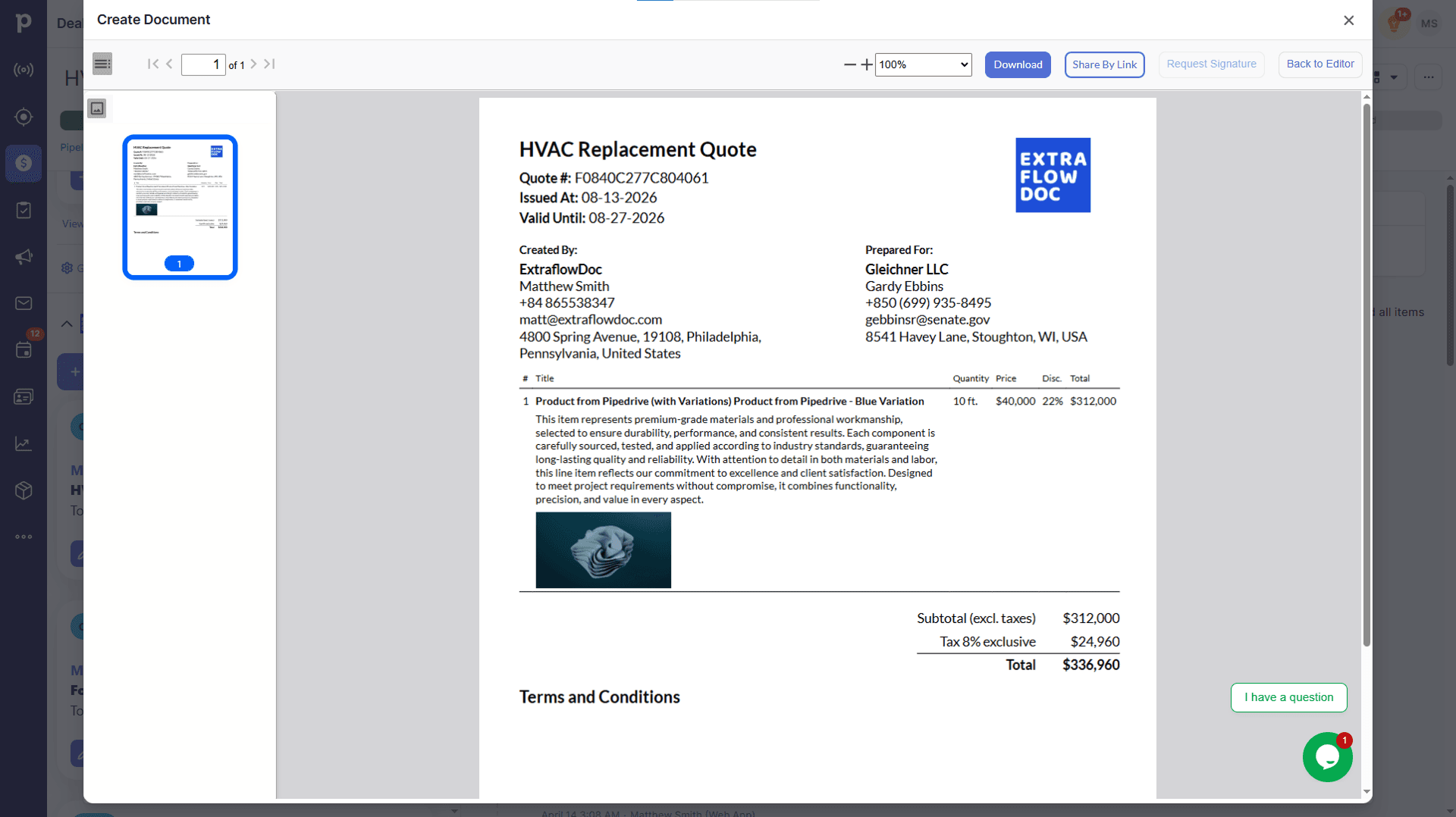
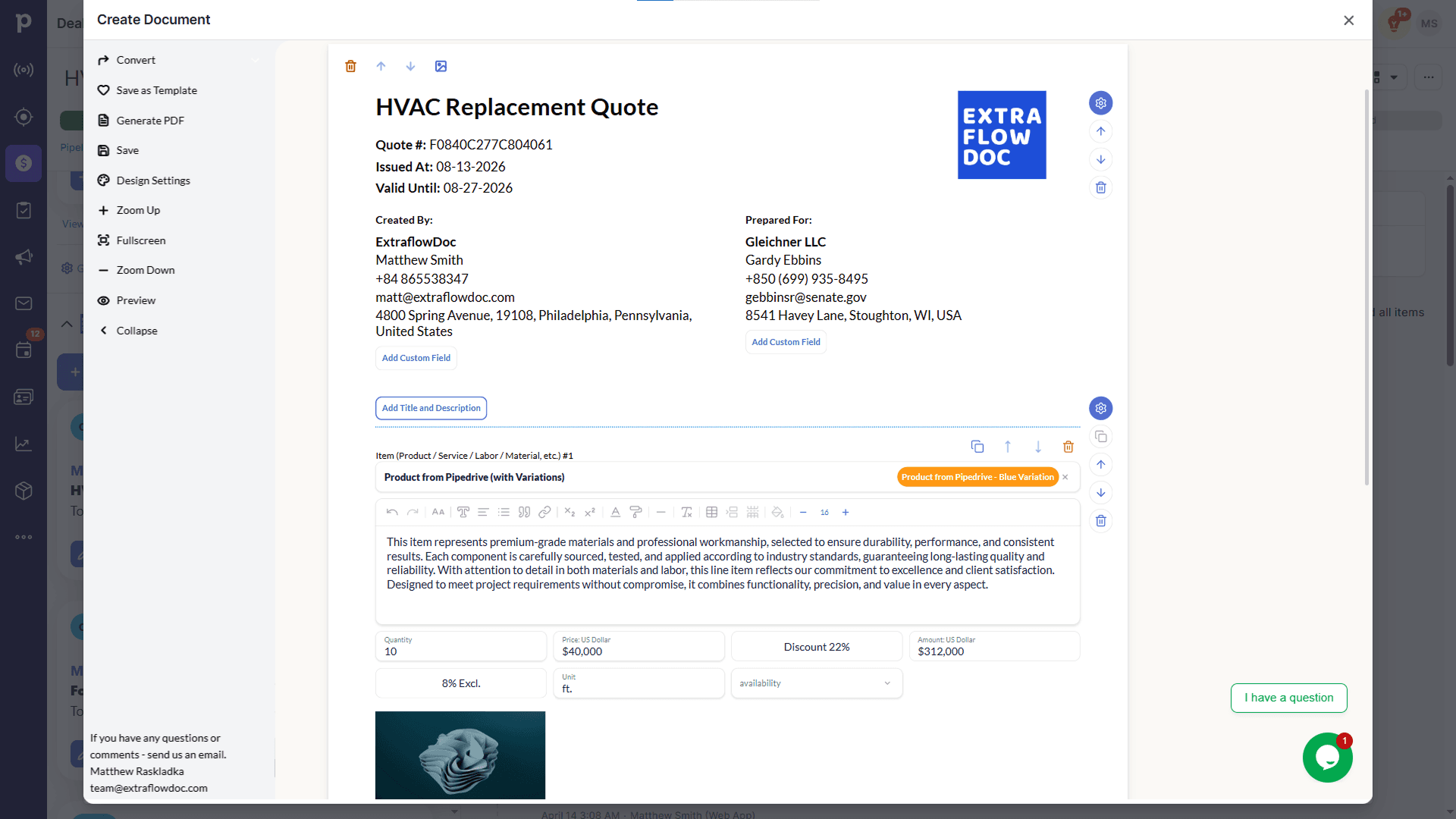
Blocks, counted lines and site photographs on the left; the finished quote the customer reads on the right. Drag the handle to compare.
Customer stories
From the trades an electrician shares a site with
“Best ROI of any software we've purchased. Paid for itself in the first week.”

“Game changer for our construction business. Complex estimates that used to take hours now take 10 minutes.”

“Very intuitive. Our team was creating professional proposals on day one with zero training.”

Integrations
Quote from the call-out you already logged
ExtraflowDoc installs into Pipedrive and monday.com and opens inside the deal or board item — so the quote starts where the enquiry, the address and the photographs of the existing board already are.

Electrical quotes in Pipedrive
Open ExtraflowDoc from the deal the call-out created. Customer, address and any custom field you map — board type, number of ways, supply rating, age of the property — flow into the quote, and your accessories sit in the product catalogue with buying prices, so you search rather than retype.

Electrical quotes in monday.com
If your jobs run on a monday.com board, build the quote straight from the item. The columns you already maintain populate the document, and the signed PDF stays on the job — which matters in electrical work, where somebody may ask what was agreed years after the certificate.
Pricing
Per company, so the whole firm quotes off the same price list
You, the second van and whoever prices the commercial work use the same plan at no extra cost — ExtraflowDoc bills on document volume per company rather than per user. Start free and move up when your quote count asks for it.
Free plan
£0.00/month
5 documents/month per company
- Estimates
- Quotes
- Proposals
- Invoices
- Agreements
- Purchase Orders
- Delivery Notes
- Work Orders
- Custom Documents
- Templates
- Integration with Pipedrive
- Integration with monday.com
- E-Signatures
- CPQ
- Tiered Pricing
- Volume Discounts
- Multiple Taxes
- Pricing Engine for line items (Price, Price + Markup, Price + Profit Margin)
Basic plan
£11.80/month
20 documents/month per company
- Estimates
- Quotes
- Proposals
- Invoices
- Agreements
- Purchase Orders
- Delivery Notes
- Work Orders
- Custom Documents
- Templates
- Integration with Pipedrive
- Integration with monday.com
- E-Signatures
- CPQ
- Tiered Pricing
- Volume Discounts
- Multiple Taxes
- Pricing Engine for line items (Price, Price + Markup, Price + Profit Margin)
Standard plan
£19.68/month
35 documents/month per company
- Estimates
- Quotes
- Proposals
- Invoices
- Agreements
- Purchase Orders
- Delivery Notes
- Work Orders
- Custom Documents
- Templates
- Integration with Pipedrive
- Integration with monday.com
- E-Signatures
- CPQ
- Tiered Pricing
- Volume Discounts
- Multiple Taxes
- Pricing Engine for line items (Price, Price + Markup, Price + Profit Margin)
FAQ
Electrical quoting software: frequently asked questions
Four of these answers are a no. People searching for «software for electricians» are usually shown design calculation, certification and price books, and this is none of those things.
What is electrical quoting software?
It is software that turns a counted job into a quote the customer can accept: points, circuits and metres as priced lines, materials and labour separated, notification and testing included, exclusions written down, and a signature at the end. ExtraflowDoc does that from the deal the call-out already created, so the quote starts from the address and the notes you took rather than a blank page.
Does it design circuits, calculate loads or size cables?
No. ExtraflowDoc performs no load calculation, no diversity, no volt drop or cable sizing, no fault current calculation and no circuit design. It picks up once you already know what you are installing: counting it, pricing it, presenting it and getting it signed. Your design stays where it is today — in your head, in a spreadsheet or in the calculation package you already own.
Does it produce EICRs, test certificates or compliance paperwork?
No, and this is the point worth being clearest about. It does not generate electrical installation certificates, minor works certificates or condition reports, does not record test results, does not notify building control or any scheme provider, and does not track your qualifications or registrations. It is commercial document software: it prices testing and certification as quote lines, and your certification package still issues the certificate.
Does it pull live prices from my wholesaler?
No. There is no wholesaler connection, so your buying prices do not refresh themselves overnight. What you get instead is a catalogue you control: your own accessories and cable with your real buying price and your selling price, searchable while you build the quote. Prices that are yours rather than a feed's, with the upkeep that implies.
Does it include a price book with labour norms?
No. There is no built-in library of labour norms or pre-priced items — nothing that tells you a double socket takes 0.4 hours. You bring your own rates, per point or per hour, and the software does the arithmetic on them. If a published price book is what you are after, that is a different product category and this is not it.
Can I price per point rather than per hour?
Yes, and it is the normal way to build a quote here. Every line carries its own quantity, unit and rate, so twenty-two downlights, nine double sockets and four circuits each sit on their own line and total themselves. You can mix that freely with day-rate lines and lump-sum lines in the same document, which is what most real electrical quotes are.
Can I show board, rewire and charge point as options?
Yes. Put two or three pricing tables side by side in the same document, each with its own lines and total. The customer picks a scope rather than picking the firm on price alone, and you stop writing the same job out three times every time somebody asks what the bigger version would cost.
Can I put a provisional sum and an exclusions list in the quote?
Yes, and in this trade they earn their place. A provisional sum line covers what you cannot see until the plaster is off, and a text block lists what you have not allowed for — making good, decorating, asbestos, a board position that turns out to be unworkable. Both are ordinary editor blocks, and both turn a surprise into priced extra work.
Can I include photographs of the existing installation?
Yes. Lines carry their own images, and full-width gallery blocks with captions sit beside the price. A photograph of the old rewireable fuse box you found, next to the line replacing it, justifies the number better than another paragraph of features — and it is also the evidence of how it stood before you touched it.
Can I get the quote signed on site?
Yes. It runs in the browser on a phone or tablet with nothing to install, so you can change a quantity in front of the customer and ask for the signature before you leave. Signatures carry email verification, a timestamp and an audit trail, and the status changes when the document is opened and signed.
Does the quote become the invoice and the wholesaler order?
Yes. A won quote becomes an invoice in one click with every line carried across, and the materials lines raise the order for your wholesaler. The quantities ordered match the ones the customer approved, because they are the same ones — which matters on a job where the margin lives in the materials.
Is there free quoting software for a small electrical firm?
ExtraflowDoc's free plan covers 5 documents a month per company with unlimited users — workable for a one-van firm quoting a handful of jobs a month. Paid plans start at £11.80/month for 20 documents, and because billing is per company rather than per user, putting a second electrician on it does not change the price.
Ready to quote the next board change?